There are few things more entertaining in the world of Armstrongism than watching Crackpot Bob announce a theological victory in a debate that never actually took place. Apparently, the latest triumph of the self-appointed leader of the improperly named Continuing Church of God involves The Confessional Lutheran podcast host who, according to Bob, was scheduled to interview him about the Trinity but eventually backed out. And naturally, Bob has already figured out exactly why.
He believes the host probably couldn't handle sitting across from the world's greatest theologian while he shares his great knowledge. Of course he does.
Why would anyone consider the possibility that schedules change, priorities shift, or a podcast host simply decides that an interview isn't worth pursuing? No, in Bob's world, there can only be one explanation: the host must have realized that he was about to encounter the theological equivalent of a nuclear explosion and wisely fled before being intellectually vaporized by the great Crackpot Bob.
Never mind that there was no debate, no exchange of arguments, no opportunity for the host to respond, and certainly no demonstrated victory. Crackpot Bob has apparently awarded himself the championship belt anyway. The opponent didn't show up, the match was cancelled, and Crackpot Bob is already standing in the winner's circle.
The debate that became a victory without a debate
According to Bob's own account, the podcast host initially postponed the interview because he wanted additional time to read Crackpot Bob's writings. Eventually, the two supposedly arranged to discuss the Trinity. Then the host backed out and stopped responding to emails.
That is the extent of what Crackpot Bob actually knows.
Everything after that is speculation.
Yet Crackpot Bob proceeds to tell his faithful readership that the host probably couldn't handle the truth, feared his audience might have trouble with it, and perhaps realized he had no valid arguments against Crackpot Bob's interpretation of Scripture and church history.
Crackpot Bob doesn't know why the host cancelled. He doesn't know what the host concluded after reading his material. He doesn't know whether the host had any intention of debating him further. But he confidently supplies the missing explanation, and naturally, the explanation makes Crackpot Bob look like the conquering hero.
This is a particularly convenient arrangement. When someone agrees to speak with Crackpot Bob, it demonstrates his importance. When someone postpones, they need more preparation. When someone cancels, they are apparently afraid of his arguments. And when someone actually disagrees with him, they simply haven't accepted the truth.
What a remarkable theological protection system! It is practically impossible for Crackpot Bob to lose an argument because he can declare victory without ever having one.
But beneath this amusing little victory announcement is something much more revealing about Armstrongism itself.
For decades, Armstrongism has devoted an extraordinary amount of energy to attacking Trinitarian Christianity. Its leaders seem almost incapable of discussing their own theological system without first taking a few swings at the Trinity.
Why?
Because the doctrine of the Trinity directly challenges one of Armstrongism's foundational theological assumptions: that God is not eternally one divine being existing as Father, Son, and Holy Spirit, but rather a family into which human beings can eventually be born as additional gods. In Armstrongist theology, God is a family, humanity has the potential to become God, and faithful Christians are supposedly destined to become divine beings just as God is.
That is the real issue.
The Trinity isn't merely another doctrine they happen to disagree with. It stands in the way of their entire theological vision of human destiny.
Consequently, Armstrongism has spent decades trying to portray Trinitarian Christianity as confused, irrational, pagan, unbiblical, and historically fraudulent. If they can convince their followers that the historic Christian understanding of God is a great deception, then their own alternative starts looking considerably more attractive.
And there is the problem: Armstrongism needs the Trinity to be wrong because its own doctrine of an expanding God-family depends upon a fundamentally different understanding of what God is. Herbert W. Armstrong built an entire religious system around the extraordinary proposition that human beings are ultimately destined to become God. Not merely to share in God's glory, not merely to be transformed into Christ's likeness, not merely to receive eternal life, but to become actual members of a divine family.
This was presented as the great mystery supposedly hidden from traditional Christianity. And what a sales pitch it was!
Traditional Christianity teaches that salvation is found in reconciliation with God through Jesus Christ. Armstrongism takes that message and adds an extraordinary expansion project: God is reproducing Himself, and the eventual result is an enormous family of divine beings. Apparently, eternity wasn't going to be interesting enough unless everybody got promoted to the Godhead.
But there is a rather important distinction Armstrongism consistently blurs. The New Testament certainly speaks about believers sharing in God's nature, becoming children of God, receiving immortality, and being conformed to the image of Christ. Those are magnificent promises. But none of that requires believing that redeemed human beings become additional Gods, equal in divine status and nature to the eternal God.
Consider 2 Peter 1:4, which speaks of believers becoming partakers of the divine nature. It does not say that Christians will become additional members of a growing collection of Gods.
Likewise, Romans 8 speaks about believers being glorified and conformed to the image of Christ. It does not announce that the Father is preparing to populate eternity with independent divine beings. Armstrongism takes these magnificent New Covenant promises and stretches them into an entirely different theological proposition.
It is quite a transformation: from becoming like Christ to eventually becoming another God.
The Trinity isn't the theological disaster Crackpot Bob thinks it is
The traditional Christian doctrine of the Trinity teaches that there is one God, eternally existing as three distinct persons: Father, Son, and Holy Spirit. It does not teach three Gods, nor does it teach that the Father, Son, and Holy Spirit are interchangeable persons.
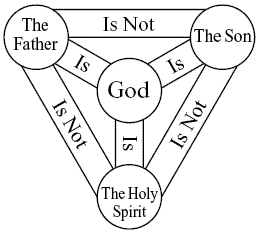
The familiar Trinity diagram Bob dismisses is an attempt to illustrate distinctions between the persons and the one divine being. It isn't a mathematical diagram claiming that one plus one plus one equals one.
Is the doctrine difficult to comprehend completely? Certainly. But difficulty is not the same thing as contradiction.
Armstrongism, meanwhile, has its own considerable theological questions to answer. If God is an expanding family, what precisely constitutes Godhood? How does the Father remain the one supreme God while countless other beings supposedly become Gods just as He is? And where does Scripture explicitly establish the Armstrongist picture of an ever-expanding divine family?
Simply declaring that the Trinity is irrational doesn't answer those questions. And calling the historic Christian understanding of God pagan doesn't make Armstrongism's alternative biblical.
One of Armstrongism's oldest habits is portraying traditional Christianity as hopelessly corrupted while presenting its own doctrines as the restoration of truths supposedly lost by everyone else.
Herbert Armstrong supposedly restored truths the Christian world had abandoned. His followers then inherited the responsibility of defending those restored truths. Later splinter-group leaders, including Crackpot Bob, came along with their own claims to special understanding and authority.
And so the restoration business continues. Every generation seems to produce another individual convinced that the rest of Christianity has somehow missed what he alone has discovered.
Crackpot Bob's particular contribution is the suggestion that the Confessional Lutheran host may have backed away because he couldn't handle the truth about the Trinity.
How convenient!
Instead of allowing the historic Christian tradition to speak for itself, Crackpot Bob positions himself as the courageous defender of biblical truth standing against an intimidated religious establishment.
It is the familiar Armstrongist narrative: everybody else is deceived, everybody else is afraid, and everybody else needs the special understanding that only the latest restorationist prophet can provide.
At some point, one might reasonably wonder whether the problem isn't that Christianity has failed to recognize Crackpot Bob's brilliance, but that Crackpot Bob has become rather too comfortable treating disagreement as evidence of his own superiority.
Perhaps the funniest part of the entire announcement is Crackpot Bob's explanation that the cancelled podcast motivated him to update his articles, revise his eBook Mysteries of God: What Is God?, and record a new sermon titled Is God One Family or One Trinity?
Well, at least something productive came from the cancellation.
The podcast never happened, the debate never happened, and the Lutheran host never had an opportunity to respond. But Crackpot Bob got a sermon out of it, updated some literature, and supplied his followers with another inspirational account of how the theological establishment supposedly trembles at the thought of confronting him.
One almost wonders what the sermon would have been called had the host actually appeared.
Perhaps: How I Defeated a Lutheran in a Debate That Actually Happened?
We will never know.
The fundamental question isn't whether Bob Thiel can find another podcast host willing to discuss the Trinity. Nor is it whether he can produce another lengthy collection of scriptures attempting to discredit traditional Christianity.
The real question is whether Armstrongism's doctrine of God and humanity's ultimate destiny actually reflects the New Covenant revealed through Jesus Christ.
The New Testament consistently directs attention toward Christ, through whom believers receive reconciliation, adoption, eternal life, and the promise of resurrection. Our destiny is to belong to God, to be transformed into Christ's likeness, and to share in the life He gives.
There is no requirement to reinvent the Godhead as an expanding corporation of divine beings to make those promises magnificent.
And perhaps that is what makes Armstrongism's obsession with attacking the Trinity so revealing. It spends so much time explaining why everybody else is wrong that it rarely seems interested in examining the assumptions upon which its own theology rests.
Crackpot Bob's little podcast adventure is a perfect illustration of the Armstrongist mindset. An interview is arranged, the other party withdraws, and suddenly the cancellation becomes evidence that Crackpot Bob's arguments were simply too powerful for a Lutheran to withstand.
There is no debate transcript, no exchange of arguments, no intellectual victory to examine, and no evidence that the host was frightened by anything Bob had written.
There is only Crackpot Bob's speculation, presented to his faithful readership as though it were an almost certain explanation.
But perhaps the greatest irony is that Armstrongism's leaders spend so much time accusing traditional Christianity of misunderstanding God while promoting a theological system that turns the Christian hope of resurrection and eternal life into an elaborate scheme of human deification.
Herbert Armstrong announced that God was reproducing Himself. His successors have been busy defending that extraordinary proposition ever since. And Crackpot Bobl, apparently, is still convinced that the greatest threat to his theological reputation is a Lutheran podcast host who might have been too intimidated to interview him.
So congratulations, Crackpot Bob!
You successfully defeated an opponent who never appeared, won an argument nobody heard, and produced a sermon about a debate that never happened.
At this rate, the only thing left is to announce that the entire Christian world has conceded defeat and is now waiting for your next revelation.
Armstrongism: Where the restoration of biblical truth never ends, the self-appointed authorities never run out of things to explain, and even a cancelled podcast can be transformed into a glorious theological victory.
The debate is over. Apparently, it never started.
Last July (see Letter to the Brethren: July 23, 2026), I mentioned that I was supposed to be a guest on a Confessional Lutheran’s podcast. The host then delayed that to better prepare himself to read more of my writings, and he set up for us to discuss the trinity on his podcast. So, I agreed and that was scheduled. But he backed out without informing us or responding to emails from our team.
In my opinion, he probably could not handle the truth and was afraid his audience would have trouble with the truth about the trinity.
The fact is that I do NOT believe that one can have a rational scriptural discussion about the beliefs of the original Christians and conclude the Church was trinitarian if one can accept the plain truth on that subject.
I speculate that the host may have seen that he did not have valid arguments against the scriptures and historical facts related to the Godhead.
Below is a drawing that trinitarians use to explain their faulty view, which logic shows contradicts itself:
(Public Domain via Wikipedia)
Anyway, partially because of the podcast host’s non-brave approach to cancelling, this motivated me to add some more to my COGwriter.com articles on the trinity, add updates to the free eBook Mysteries of God. What is God?, and decide to give one or more future sermons on the trinity.
And one of those sermons is what I recorded several days ago.
And now you also have a background story on its development.


No comments:
Post a Comment