Wednesday, May 28, 2025

You Did Not Hear Dave Pack Say This: Christ Returns On Pentecost (June 1, 2025)


During "The Greatest Untold Story! (Part 573)" on May 3, 2025, David C. Pack of The Restored Church of God teaches that the Kingdom of God and Jesus Christ will arrive on Pentecost this year at dawn on June 1, 2025. For reference, David C. Pack taught that Jesus Christ would return on Pentecost in 2019 
during Parts 177 and 178. All credit to former member Marc Cebrian for this clip and description: exrcg.org

RCG: Pack Predicting Pentecost? Aide to Ohio Church Leader Denies New Date Set


Pack Predicting Pentecost? Aide to Ohio Church Leader Denies New Date Set

Video shows minister saying June 1 return of Jesus 'easy' to prove

MAY 27, 2025


If at first a pastor is wrong, does he try, try again?

Maybe not. A spokesman for a small church denomination in northern Ohio denies online claims that its leader is predicting the return of Jesus Christ will occur Sunday, June 1.

“That is not something that the Restored Church of God teaches, or that Mr. Pack is claiming,” Edward Winkfield said in a phone interview Tuesday, May 27.

David Pack, the founder of RCG, has been accused of setting failed dates many times in messages to his headquarters congregation. Former member Marc Cebrian has posted dozens of video clips from Pack's sermons to illustrate that.

“It is interesting that it was coming from someone who was being critical,” Winkfield said. “But I can say unequivocally that is not what we teach.”

Cebrian might respond by saying that's because Pack has revised the Pentecost date again. Cebrian's website showed two predicted return dates Tuesday: June 1 and June 11.

Cebrian's ExRCG.org blog did not explain the later date, except that it was a full moon. But one video clip dated Saturday, May 3 shows Pack defending his Pentecost reasoning.

“God would never say regarding the arrival of His Kingdom, 'It's Pentecost,'” Pack said. “He almost does a number of times, in ways that are impossible to misunderstand.”

But, Pack added, God stops short of providing a specific date in the Bible because “the whole world would know.”

An earlier article cited clips posted by Cebrian in which Pack predicted Christ's return on Sunday, March 30, the start of the Hebraic calendar year. He called that date “immutable church doctrine”.

“The second coming of Christ is a pretty foundational doctrine in any Christian, Bible-teaching church,” Winkfield said when asked about that. “We study prophecy... it's part of what we teach.”

Winkfield added RCG is a group which “remains hopeful... more than anything definitive.

“Maybe you could go as far as speculating different things, but I wouldn't take it as anything beyond that,” Winkfield explained.

Yet Pack's early May video claims that proving Pentecost as the return date is like “falling over backwards without even being pushed. It's that easy.”

Pack goes on to cite a main Bible verse quoted by opponents of prophetic date-setting. Jesus said of end-time events in Mark 13:32, “Of that day and hour no one knows, not even the angels of heaven, nor the Son, but only the Father.”

“Well, we know both,” Pack claimed in the early May video.

Winkfield, RCG’s Publications and Media Director, admitted he doesn't know the motives of RCG critics. Cebrian's website says its goal is “exposing the truth” about RCG and Pack.

Pack would not be alone in expecting a second coming of Jesus on Pentecost.

Ron Weinland, leader of the Church of God-Preparing for the Kingdom of God in northern Kentucky, predicted Jesus would return first on Pentecost 2009, then Pentecost 2012.

Days after the 2012 prediction failed, Weinland was convicted by a federal jury on five counts of tax evasion. Weinland's website biography says he was “falsely imprisoned by the government of the United States,” with a sentence of 3.5 years.

But newspaper accounts of his trial say Weinland's attorneys admitted he moved church funds to a Swiss bank account. Weinland reportedly thought the U.S. economy was on the brink of collapse.

Both Pack and Weinland's groups are related to the Worldwide Church of God, made famous by Herbert Armstrong through The World Tomorrow broadcasts of the 20thcentury.

Both ministers left WCG (now Grace Communion International) after the denomination made major changes in doctrine years after Armstrong's death.

Not every WCG spinoff group preaches that the second coming will occur on Pentecost. Without setting dates, they hint a Biblical timeline of salvation points to Jesus possibly returning on the Jewish “Feast of Trumpets” or Rosh Hashanah.


Subscribe to Richard’s Substack

By Richard Burkard · Launched 4 months ago
My personal Substack


Tuesday, May 27, 2025

Black and CULTivated: Our Cult was Fun!


As we wrap Season 1 of Black and CULTivated, I sit down with two of my childhood friends Jen and Genise — whom I grew up with in the Worldwide Church of God. 👀✨ In this episode, you’ll hear a little more about my story and how the three of us slowly realized… yeah, we were 1000% raised in a cult. 😅 It’s a straight up kiki — full of laughs and those “wait, did that really happen?!” moments. This episode truly captures what Black and Cultivated is all about: telling the stories of Black and Brown cult survivors with humor, heart, and a whole lotta honesty. Thank y’all so much for rocking with us this season. You can’t get rid of us that easy though — bonus episodes and a Season Two announcement are coming soon 👀🤞🏾.

Touch Not the Scroll That Gloweth: On the Spiritual Dangers of Electronic Bibles


Touch Not the Scroll That Gloweth: On the Spiritual Dangers of Electronic Bibles

By Elder Rev. Dr. Percival Thaddeus Grone


Beloved Saints and Those Yet Unplugged,

I have read with a mixture of gratitude and grave concern the recent ministerial report from Charlotte, in which Presiding Evangelist Gerald E. Weston raises a cautious hand regarding the use of electronic Bibles from the pulpit. While I commend Brother Weston—long respected for his efforts to preserve what remains of order in the Church—for identifying a potential spiritual compromise, I must note that his language bears the soft edges of a newer dialect, one more common among the cautious pragmatists than the prophetic remnant.

He speaks of “rare and legitimate exceptions.” He acknowledges the usefulness of digital tools. And thus begins the descent.

It saddens me, truly, to see even formerly unmoving pillars begin to lean—ever so slightly—toward the flickering glow of cultural accommodation. What begins as allowance soon becomes adoption; what is tolerated from the pulpit today is translated into doctrine tomorrow. Brother Weston speaks of “unintended consequences.” I speak of incipient digital abomination.

Let us be clear: this is not a matter of screen vs. page. This is a matter of scroll vs. sorcery.

Of Tablets and Temptations

It was upon stone tablets that the original Commandments were delivered. Stone, beloved. Not plastic. Not lithium. And certainly not something requiring a USB-C to receive divine power. To hold a glowing rectangle aloft in the pulpit is not merely poor optics—it is optical delusion. The flickering glow of an e-reader is no match for the weight of vellum and ink. A Bible app may contain the words of Scripture, but it is not the Word. It is a replica of righteousness, a simulacrum of sanctity, a backlit blasphemy.

Does the serpent not also illuminate? “For Satan himself is transformed into an angel of light” (2 Corinthians 11:14). And yet we bring forth light from our laps and call it holy?

Swiping Away the Sword

In the glory days, a man knew his Bible. He turned its pages, and the rustling of onion-skin parchment was as the sound of the Spirit moving over the face of the waters. Today, the page is replaced by the swipe—an action nowhere endorsed by apostolic hand. With each swipe, we lose our grip. The sword of the Spirit becomes not a double-edged blade, but a blinking cursor.

Shall we not consider how swiftly heresy spreads when transmission requires no ink? When a false gospel may be downloaded in milliseconds? When the red-letter words of Christ are displayed in Comic Sans, beneath a notification from TikTok?

Indeed, I recently witnessed a young minister attempt to quote Habakkuk, only to be interrupted by a push alert from something called “Fantasy Football.” I ask you: what is fantasy, if not doctrine divorced from discernment?

The Scroll as Covenant


Brethren, the book—the physical, printed book—is not a convenience. It is a covenantal object. When a man opens the leather-bound Word, he is not merely reading; he is entering into a tactile pact. He feels the covenant. The crackling of the spine, the marginalia of his forebears, the faint scent of mildew and sanctification—all these things testify that the Word of God is not a thing to be streamed.

No revival has ever broken out over a Kindle.

The Rise of the Digital Beast


Let us now speak plainly: this is not just a technological transition. It is the soft preamble to the Beast System. When the Man of Sin arrives, he shall not wield a scroll. He shall brandish a device. And many shall say unto him, “Siri, open to Matthew chapter 24,” and it shall be opened—but it shall not be understood.

Revelation warns of a mark without which no man can buy or sell. Might we also imagine a future in which no man can preach or teach without first logging in?

Already I have heard whispers of algorithmic translations—Scripture adjusted in real time to suit the emotional needs of the reader. This is not exegesis. This is exe-gnosis—the hidden, digital heresy of those who seek to code the cross.

Prescriptions for the Elect

To those who are tempted by the convenience of glowing Bibles, I offer these apostolic remedies:
  • Preach only from a hard copy, preferably one bound in animal hide, not neoprene.
  • Never trust a verse that comes with a hyperlink.
  • Refrain from charging your Bible. The Word of God requires no adapter.
  • If your Bible requires a software update, throw it into the sea (Revelation 18:21).
If you must use an electronic Bible due to failing eyesight or weak lighting, cover the device with organic sackcloth when not in use, and make daily intercession for discernment lest you be led astray by the “scrolls of silicon.”

Final Exhortation

Brother Weston’s concern is not misplaced, only mismeasured. We cannot afford to manage this issue with administrative restraint when apostolic urgency is required. We must not settle for policies when the times demand prophecy.

Let the remnant remain watchful. Let us not trade ink for interface. Let us not exchange the scroll for the screen. For the Word was made flesh—not firmware.

Stand firm. Turn pages. Resist the swipe. And remember, “Thy word is a lamp unto my feet”—not a blue light unto my face.

Steadfast in print,

Percival Thaddeus Grone

Elder Rev. Dr. Percival Thaddeus Grone

Senior Lecturer in Scrollology and Prophetic Interface Studies.
Dean Emeritus of the Portable Tabernacle Technology Advisory Board
Still Watching Since 1844

When the WCDebris Tells You One Thing and Your Stomach Tells You Something Else, The WCDebris is Lying to You


The Old and New Testament is filled with men who are sure that "the Lord spake unto me thus..." Evidently, they kinda take it for granted they deserve to be believed or that for sure it was really God speaking to them and not their disordered personality quirks. 

If, in the NT, the Apostle Paul says he went to the 3rd Heaven and saw things he can't or is not permitted to reveal, then it must be true, right? 

If he says " I want you to know, brothers and sisters, that the gospel I preached is not of human origin. I did not receive it from any man, nor was I taught it; rather, I received it by revelation from Jesus Christ," it must be true, right? 

So it was and yet is still with the stars of the WCDebris to this day. 

Here's a good modern example of perceiving the "cannot be argued" improbable and when politics and delusional religious beliefs mix.


Speaker of the Houe, Mike Johnson, Claims That God Prepared Him to Be a “New Moses”


"The Lord impressed upon my heart a few weeks before this happened that something was going to occur. And the Lord very specifically told me in my prayers to prepare but to wait. I had this sense that we were going to come to a Red Sea moment in our Republican conference and the country at large.

Look, I’m a Southern Baptist. I don’t want to get too spooky on you, OK? But the Lord speaks to your heart. And he had been speaking to me about this.

And the Lord told me very clearly to prepare. OK, prepare for what? I don’t know. “We’re coming to a Red Sea moment.” “What does that mean, Lord?”

I started praying more about that. And the Lord began to wake me up through this three-week process we were in, in the middle of the night, and to speak to me. And [I began] to write things down, plans and procedures and ideas on how we could pull the conference together. I assumed the Lord was going to choose a new Moses. And “Oh, thank you, Lord: You’re going to allow me to be Aaron to Moses.” [In the Hebrew Bible, Aaron is Moses’ brother and a priest who aids him.]

I worked to get Steve Scalise elected. And then Jim Jordan. And Tom Emmer. Thirteen people ran for the post. The Lord kept telling me to wait. And I waited and waited. And it came to the end, and the Lord said, “Now, step forward.” “Me? I’m supposed to be Aaron.”

 “Only God saw the path through the roiling sea,” he concluded.

===========================

I have no doubt Mike Johnson is sincere. Or at least I hope so. 

It has to be some kind of high to imagine the gods or THE GOD has noticed your potential to fulfill His and end time needs. Dave Pack has latched on to the fact that God even named him "David Passover" and that he sees himself in just about every important Biblical character predicted in the scriptures.  Why he is even amazed in his name being "David" like Bible David and now, whenever he reads "David" in the scriptures, it's really him! It can't be just a coincidence. It's impossible and, frankly, cannot be argued with. It is inarguable. 

But yet it is delusional theology and belief. 

=================

What Critics Are Saying

Johnson's speech drew criticism online from figures like Mary Trump, the estranged niece of former President Donald Trump who is a frequent critic of conservative politicians.

"If Mike Johnson doesn't believe this, he's a manipulative cynic," Mary Trump wrote on X. "If he does, he's psychotic. Either way, he's a massive megalomaniac. If he wants to pretend he's Moses, he can start by removing himself to the desert for 40 years."

David Cay Johnston, an investigative journalist and author of the book, The Making of Donald Trump, also called Johnson's speech "deeply disturbing".

Same comments for the WCDebris , Dave Pack, Gerald Flurry, Ron Weinland, Bob Thiel and all the assorted Prophets, Priests, Elijahs to Come, Messengers of Covenants, That Prophets and multiple copies of the Two Witnesses yet to be revealed. 

Of course, no God spoke to anyone, but it plays well to some. Not to many actually for it smacks of self-serving mental health issues which seem to show up more readily in those seeking power, money and authority over others.  

I have noted over the years that it is much easier for a man with mental health issues and possible personality disorders to hide in a church than to hide in a secular workplace. The quirkiness and even authoritarian tendencies seem like some kind of deeply spiritual superiority and conversion others just can't attain to. It is not. It is a man hiding in a church with mental health issues and probable personality disorders undiagnosed saying and doing ridiculous things. 

When they do it often enough, you kinda get used to it and forget it's nonsense. 

It seems politicians and preachers are particularly prone to this problem. It plays well to the less than critically thinking. 

Jeremiah, for all his depressive perspectives seems to at least understand the truth of his own times.

Jeremiah 23:21

“I have not sent these prophets, yet they run around claiming to speak for me. I have given them no message, yet they go on prophesying.

May I suggest Dave Pack, Ron Weinland, Gerald Flurry and Bob Thiel, join On and On Anonymous and talk it out with other like-minded delusional religious addicts?

======================


Monday, May 26, 2025

Gerald Weston on the "unintended consequences of using electronic Bibles to preach from"

It's another bright day in California, and Armstrongism's fervor persists unabated, with the Living Church of God delivering as expected! Gerald Weston posted a piece questioning whether ministers should use an iPad or similar device as their Bible source during sermons. True ministers, it seems, stick to a physical Bible, color-coded and worn from years of use. Flipping through delicate onion-skin pages trumps typing in a verse or book. Plus, fumbling through the Bible can eat up at least 20 minutes of a sermon—especially for preachers who insist on citing 500 verses, perhaps to wow the congregation sitting on those chilly metal chairs.

Weston goes on to declare below that there may be "...potential unintended consequences before it is too late to “get the cows back in the barn."


Greetings from Charlotte, 
 
We held an hour-and-a-half online meeting for ministers worldwide on Wednesday. Mr. Rod McNair addressed several procedural subjects for our ministry. Dr. Douglas Winnail addressed what it means to be a “Pastor Emeritus,” whether or not we can use gluten-free bread for Passover, and circumcision. I spoke about how to deal with remote GOTOs and the use of electronic Bibles in preaching. 
 
On that subject, I acknowledged that electronic Bibles are powerful tools we can use in studying the Bible, and there are situations where it may be necessary to use them from the pulpit, such as when one has bad eyesight or is preaching in a congregation with poor lighting. But there are likely to be unintended consequences. Those of us who have studied the Bible for decades have a foundation that we may not fully appreciate when it comes to how the Bible is laid out and fits together. Those cutting their teeth on electronic Bibles most likely do not have the same overview. They may be able to jump back and forth from one translation to another—and this can be a wonderful study tool—but are they building a firm foundation on a recommended translation? Only now, after “the cows are out of the barn,” have we learned the dangers of social media—even from some of the executives behind it. We need to consider potential unintended consequences before it is too late to “get the cows back in the barn.” That is why I have asked our ministry to use a hard-copy Bible from the pulpit except in those cases that present rare and legitimate exceptions. 
 
—Gerald E. Weston


Sunday, May 25, 2025

CGI and The Great False Church LIE

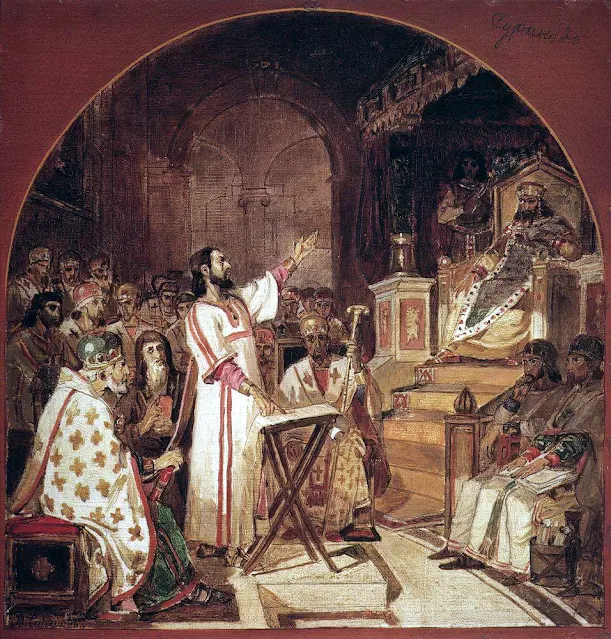
The First Council of Nicaea by V.Surikov 1876


The Great False Church LIE


Herbert Armstrong inherited an anti-Catholic narrative from an extreme 19th Century Protestant (Alexander Hislop) and embellished it with some of the false history created by Sabbatarian Protestants written in the same era. According to this narrative, a great false church had arisen centered on Rome and founded on the ancient pagan traditions which preceded it. Indeed, for Herbie and his followers, the Roman Catholic Church was the Great Whore of Babylon mentioned in the book of Revelation! Indeed, central to Herbie's narrative was a grand satanic conspiracy to change the day of Christian worship from the Saturday Sabbath to the Pagan Day of the Sun which took place at the behest of the Roman Emperor Constantine in the 4th Century. The only problem with this narrative is that it is NOT supported by Scripture or the historical sources available to us!

Unfortunately, this false history of Christianity continues to be trotted out to the members of the Armstrong Churches of God to this day! Perhaps, the most conspicuous of these is Bob Thiel of the so-called Continuing Church of God, but most of the other descendants of the Worldwide Church of God also continue to offer this false history to their members and the world. Indeed, even the so-called "liberal" ACOGs, like the Church of God International continue to promulgate Herbie's lie!

Notice this recent statement from CGI Medina's Jeff Flanick which is excerpted from a post he wrote about the new pope: The Council of Nicaea paved the way to officially “change” the Sabbath to Sunday, initiated the introduction of the doctrine of the Trinity, and fully replaced God’s Passover with a solar calculated “Easter” (in a convoluted and twisted formula) to “justly” separate themselves from Jewish worshippers of the “Way” concerning Pascha {Passover}). The Council, in conjunction with Emperor Constantine, paved the way to institutional ‘religion’ and the marriage of church and state. (Please take note, I’ve provided some links for your consideration about the First Council of Nicaea at the end of this article. I’m sure you will find them very interesting and quite educational!) Which Lion Should We Follow? by Jeff Flanick of the Medina CGI.

From the very first source which Jeff cited (an article for The Sabbath Sentinel entitled The Council of Nicaea and the Sabbath, we read: Hosius of Cordova was a religious advisor to Constantine and presided over the council until the emperor arrived. Hosius was likely the one to convene the meeting and invited the emperor to participate and make final decisions – in a manner like Arles. The emperor arrived about a month into the proceedings of Nicaea. At the council, decisions were made concerning Arius and the Meletians. Twenty canons, or church principles, were also passed. None of them mention the seventh-day Sabbath. At the end of the meeting, there was a letter composed by Constantine which mandated that all churches follow the Roman rite as it comes to the observance of Pascha. This composition is the basis for some who claim that Constantine changed the Sabbath. Likewise, in the conclusion to this same article, we read: The rulings at Nicaea did not stop people from keeping Pascha in a manner like the Jewish people. References to Christians keeping Passover like the Jewish people are found decades later in writers such as John Chrysostom (Eight Homilies Against the Jews) and Epiphanius (Panarion, sections 50 and 70) as well as church councils such as the Councils of Antioch (341) and Laodicea (364). Many people are not aware the Nicaea addressed many of the same issues as the Council of Arles eleven years earlier. This knowledge and the proper context of Constantine’s letter help us to understand that Nicaea had zero impact on the Sabbath.

Jeff's second source, an article penned for the United Methodist Insight titled The Sin of Nicaea, informs us that: In 325 C.E., just 12 years after the Emperor Constantine declared Christianity to be a legal and acceptable religion, he convened the Christian bishops from across the Roman Empire at the Council of Nicaea to come to agreement about the official doctrines of the church. He was particularly concerned about the divisions in the church in relation to a way of thinking called Arianism, which held a view of Jesus as not being co-eternal with the Father and thus being distinct from and subordinate to the Father. A little later, in the same article, we read: There is nothing wrong or inappropriate about church leaders coming together to seek common understanding and agreement about their views concerning the divinity of Jesus. That is not the problem with the Council of Nicaea. The sin of Nicaea is not the seeking of common understanding, rather it was what was done to those who dissented from the majority view. Once again, there is NO mention of the Sabbath!

Likewise, Jeff's third source, an article from Stand to Reason titled The Doctrine of the Trinity at Nicaea and Chalcedon included Nicaea as an important step in the formulation of Trinitarian theology. Moreover, the author made clear that the story of the development of this doctrine is one of a careful and faithful process. Indeed, in the opening to the article, we read: The formulation of the doctrine of the Trinity is a history of the refinement of terms and philosophical categories. Proper terminology was a primary issue of the ecumenical councils of the fourth and fifth centuries, and so was precision of thought and the philosophical categories used to characterize the Trinitarian and Christological doctrines. The Council of Nicaea resolved the question of Jesus’ deity, but led to further dissent about Jesus’ human and divine natures. These issues culminated in the expression of the doctrine at Chalcedon. Continuing, we read: The impressive thought and debate that went into the Councils of Nicaea and Chalcedon produced biblically sound, but also intellectually virtuous doctrines. F.F. Bruce expresses the importance of accurate language in the creeds: “Inasmuch as the deity of Christ and the doctrine of the Trinity are embedded in the New Testament, although not explicitly formulated there, we must make the effort of wrestling with difficult terminology if we are not to fall an easy prey to misunderstanding or to actual heresy.” Doctrinal development requires rigorous intellectual skills and sound philosophic categories to accurately apply God’s revelation.

Do we discern a pattern beginning to emerge with Jeff's sources? NONE of them support his and Herbie's narrative about the Roman Catholic Church or traditional Christianity! The same is also true of the other two sources jeff provided.

What is the real history of the Church and its relation to the Sabbath, doctrine of the Trinity, and the observance of Pascha/Easter? The real story is that the relationship of Christians to the commandments of Torah was clearly spelled out in the canonical books of Acts and Galatians (Acts 15:1-30 and Galatians 2:1-16). Yes, Jesus and his original twelve apostles observed the commandments of Torah, because they were JEWS! Gentiles didn't have any tradition of a weekly Holy Day, like the Sabbath!

The truth is that after the Romans destroyed Jerusalem (and the Temple) in 70 C.E., Sabbath and festival observance ceased among Jews and Jewish Christians! Indeed, by the end of the First Century, the observance of the Lord's Day (commemorating the resurrection of Christ) was almost universal. Likewise, the Trinity is implicit in the writings of the New Testament (see John 1:1-34, 10:30, 14:16-17, Matthew 3:16-17, 28: 19, Luke 1:35, I Corinthians 8:6, 12:13, II Corinthians 13:14, Colossians 2:9, etc.). As for Pascha/Easter, the sources already cited suggest that the Council of Nicaea's purpose was to standardize its observance to one day each year on the Roman calendar (which most of the known world was using).

In other posts on this blog, we have also quoted from the writings of early Christians - proving that things like Christians using Sunday to worship originated in the First Century (see The Didache, the letters of Ignatius of Antioch, and the writings of Justin Martyr) and was already common practice by the time of Constantine and the Council of Nicaea.

Finally, we have the Church History composed by Eusebius in the Fourth Century. In that history, we see a frank account of the unsettled nature of the canon for the first two hundred years of the Church's history (see Book 3, Chapter 25). He also had this to say about a sect of early Christians who continued to observe the tenets of Torah, including the Sabbath:

1. The evil demon, however, being unable to tear certain others from their allegiance to the Christ of God, yet found them susceptible in a different direction, and so brought them over to his own purposes. The ancients quite properly called these men Ebionites, because they held poor and mean opinions concerning Christ.

2. For they considered him a plain and common man, who was justified only because of his superior virtue, and who was the fruit of the intercourse of a man with Mary. In their opinion the observance of the ceremonial law was altogether necessary, on the ground that they could not be saved by faith in Christ alone and by a corresponding life.

3. There were others, however, besides them, that were of the same name, but avoided the strange and absurd beliefs of the former, and did not deny that the Lord was born of a virgin and of the Holy Spirit. But nevertheless, inasmuch as they also refused to acknowledge that he pre-existed, being God, Word, and Wisdom, they turned aside into the impiety of the former, especially when they, like them, endeavored to observe strictly the bodily worship of the law.

4. These men, moreover, thought that it was necessary to reject all the epistles of the apostle, whom they called an apostate from the law; and they used only the so-called Gospel according to the Hebrews and made small account of the rest.

5. The Sabbath and the rest of the discipline of the Jews they observed just like them, but at the same time, like us, they celebrated the Lord's days as a memorial of the resurrection of the Saviour.

6. Wherefore, in consequence of such a course they received the name of Ebionites, which signified the poverty of their understanding. For this is the name by which a poor man is called among the Hebrews.

(See Church History, Book 3, Chapter 27, "The Heresy of the Ebionites")

Thus, we see that Herbie's and Jeff's narrative about Church history is NOT consistent with the sources available to us. Their narrative regarding the "change" from Sabbath to Sunday happening in the Fourth Century under the Roman Emperor Constantine is NOT supported by the evidence available to us. Likewise, their attack on the Trinity fails on both the Scriptural and historical fronts. In fact, their history of how Sunday, the Trinity, and Pascha/Easter were borrowed from paganism and instituted by the Great False Church is shown to be a bold-faced lie! Even so, don't look for them to ever update their historical accounts of Church history, because their false historical narrative supports their heretical teachings. After all, if the truth of what actually happened in the past is too embarrassing, or doesn't support your narrative, you simply modify it - right?


Miller Jones/Lonnie C Hendrix