Thursday, September 19, 2024

Satan Attacks The Greatest Church of God In Human History...Again!


Poor Bwana Bob, Satan is always out there trying to thwart his mind-boggling work in one way or another.

Greetings from the Five Cities region of California. 
 
Yes, we have received more translations of our English language booklet, The Gospel of the Kingdom of God this week. As mentioned before, this assists us in our efforts to support the fulfillment of Matthew 24:14. 
 
That said, we have been hit by a major computer glitch and this is affecting our ability to do mailings, etc. Please pray that God’s will will be done and that this will be resolved without major data loss.

Amy Sherald, Former WCG Member Who Painted The Michelle Obama Portrait


Sherald painted this now-famous painting of Michelle Obama 
that hangs in the 
National Portrait Gallery of the Smithsonian.


"Sherald became famous after her portrait of the former first lady, Michelle Obama, was unveiled in 2018. Attention grew with Sherald’s portrait of Breonna Taylor, the Black medical worker who was killed in 2020 by police in Louisville, Ky., during a raid on her home. It remains one of the best known pictures of protest and resilience to come out of the Black Lives Matter movement."

"Born in Columbus, Ga., Sherald was brought up in a religious family. Her father, a dentist and a trumpeter, had them join the fundamentalist Worldwide Church of God; the Sheralds were its only Black members, she recalled. They celebrated the Sabbath on Friday night and Saturday; honored Old Testament holy days, including Passover, during which they ate matzoh; and dispensed with Christmas and Easter, as well as birthdays and Halloween. All-white, too, was the Catholic school Amy attended from kindergarten through high school.

She knew from second grade that she wanted to be an artist, and that it would involve hard work. She also would have to sort out a rather complicated identity. Her maternal great-grandfather, she explained, was a German Jew named William. “The story we have is that he was a tailor,” Sherald said, and that “my great-grandmother married a Black man, but she did have these two children with William.” When Sherald entered Clark Atlanta, a historically Black university, she left the church and did not return."

Full article here: Amy Sherald, Brazen Optimist

GCI: New Issues Arise Causing Restructuring Of The Church


Things are not as rosy as they used to be in GCI as men are retiring, and no one is available to replace them, leading to "incredibly challenging and painful decisions and even more difficult conversations with our pastors and facilitators."

GCI in the United States has been undergoing major restructuring throughout 2023 and 2024. These changes have occurred for several reasons. The main reason is a shortage of pastors and key leaders to replace our ranks. For the past 12 years, our regional system has served us well. We started with six regions. With the retirement of Ted Johnston, it went to five regions. In January 2024, Anthony Mullins left the role of Southeast regional director (RD) to plant a GCI congregation in Durham, North Carolina. Then in January 2025, Rick Shallenberger, North Central RD, and Tim Sitterley, Western RD, will both be retiring. This means Dr. Jeff Broadnax, Pam Morgan, and I will be sharing the responsibilities of overseeing the United States. I also have the responsibility of overseeing the Canadian and the Caribbean regions. We hope you can understand that we clearly needed to make some changes to manage this vast area with fewer people. 
 
One option was to move our more experienced pastors from their current congregations to the role of RD, but this would put these large, healthy congregations at risk. Robbing Peter to pay Paul is never a good strategy for growth nor sustainable health. So, the Holy Spirit has been leading us to think differently and guiding us to implement a new strategy. However, this new strategy has required incredibly challenging and painful decisions and even more difficult conversations with our pastors and facilitators.

Many of their smaller churches and Zoom groups will no longer have a "charter" or support from HQ.

We changed our chartering guidelines in 2023 and revised them in 2024. Groups who meet via Zoom but do not meet face-to-face weekly, no longer have a charter. We also are transitioning groups of less than ten in weekly face-to-face attendance to closed status, and they will no longer have a charter. Of course, most will continue to gather and fellowship as small groups as they are able, but it is not wise stewardship of limited resources for the denomination to continue to insure them nor support their charter. None of these decisions has been easy for the facilitators, members, RDs, or the home office staff. We all grieve and lament with those our decisions have affected. I have struggled with bouts of depression due to these transitions and closures. This is, however, necessary if we are to oversee and properly lead our groups who have a weekly attendance of more than ten people.

Apparently income is also down.

The members and leaders affected by the restructuring are our brothers and sisters, our fathers and mothers, and our grandmothers and grandfathers, and we love and appreciate them very much! And it is also true that we cannot continue to provide support for the number of groups we previously supported and still provide training and the necessary accountability to help turn the corner to be a growing and thriving denomination. We do not want to leave anyone behind, so we have created the Home Church US. Pam Morgan has written an article to help explain what this is and how it works. Read it here.

I want to remind us that the “church” is not buildings or specific meetings — it is the people. Along with all Christians around the world, it is you and I, together, who make up the church, the body of Christ, the bride of Jesus. No one can remove you from God’s church. It is a covenantal relationship we each have with our God, as Father, Son, and Spirit, because of what Jesus did on our behalf. We belong to him, and no one can snatch us out of his hand. (John 10:28-29) Remember, he will never leave us nor forsake us! (Deuteronomy 31:6)

They remind members that all churches have a life cycle and most die off. Well, that pretty much describes the Worldwide Church of God and Armstrongism!

I also want to remind us that everything living has a life cycle and that includes congregations and fellowship groups. The apostle Paul planted congregations, yet they no longer exist today. Did Paul fail? Did those congregations fail? No, we are all here, in part, because of the work the Holy Spirit did through Paul and those congregations. Jesus tells us that he will build his church and even the gates of hell and death will not prevail against it. (Matthew 16:18) Jesus never said a congregation or group of people will always exist in their current form until he returns.

I thank each one of you and am grateful for your love for God, love for his children, and your years (and even decades) of support and prayers. I apologize to those hurt by these transitions. To cause hurt has never been our intent, nor what is in our hearts. Like me, I know you love this denomination and want to see it thrive. I covet your continued prayers for God’s provisions and direction, as we try our best to follow the leading of the Holy Spirit. Love you all!

Mike Rasmussen, Superintendent of North America & the Caribbean

Tuesday, September 17, 2024

The Truth. Does LCG Even Know What It Is?


Did you know that truth and your capacity to understand the scriptures, what the plan of God is, and your part in that plan is only available through the Living Church of God? Who knew?

Be Thankful for the Truth: The Sabbath is a good time to reflect on the question: Are you thankful for the Truth? If you are a lifelong member or if you grew up in the Church, it is easy to take the Truth for granted. Yet, Jesus said that no one can come to a real understanding of the Truth unless they are called and their minds are opened (John 6:44). The capacity to understand the Scriptures, the plan of God, the purpose of life, and God’s way of life is a gift that God is only making available to a few at this time (1 Corinthians 1:26–27), because Satan has blinded the eyes of most people of this world (2 Corinthians 4:3–4). Jesus stressed that it is a great privilege to be given an understanding of the Truth of God (Matthew 13:10–17). The Apostle Paul stated that to be called out of darkness into the Truth is something to be extremely thankful for(Ephesians 5:8–20). Let’s never lose sight of this incredible privilege. Are you thankful for the Truth?

Have a profitable Sabbath,

Douglas S. Winnail

Feast of Trumpets Is Approaching And LCG Goes Into Fear Mode: Beware Of Those Rascally Germans!


Those rascally Germans, always stirring things up in COGland. When will they ever stop pestering the Churches of God? Living Church of God would have no reason to exist if it wasn't for Germany.

The fear factor is constantly alive and well in Armstrongism

We are now less than three weeks away from the Feast of Trumpets and as experience tells us, it will come quickly. Similarly, although we appear to be some years away, the day the Feast of Trumpets pictures will be here much more quickly than we might imagine. Germany is taking a turn to the right and cracking down on immigration. Events in Europe are setting the stage for the fulfillment of prophecies that we have known for decades must happen. Here in the United States, this is likely to be the most consequential election in memory, but who knows how it will turn out, what the fallout will be whichever candidate is elected, and most importantly, who God will choose, as He can turn elections in whichever direction He chooses. Leaders do make a difference, but anyone placing his trust in man and in our democratic approach to choosing our leaders is destined to be disappointed.—Gerald Weston


Counterpoint: God’s Law vs. The Law of Moses


We have had an engaging conversation about the law in a previous post. Here is another viewpoint from the other side of the conversation by Concretized Christianity. I don't normally do this when it comes to certain groups trying to get their own sometimes convoluted message across, but I have been in contact with theses folks over the years and respect them for their various stances that sometimes go against the grain of normal COG thoughts.

God’s Law vs. The Law of Moses

From The Beginning

There is a lot of talk both within and without the COG groups about keeping the “law of Moses.” Those against it say it’s part of the old covenant and since we’re under the new covenant, we no longer have to keep those laws. And, sadly, in some ways, the COG groups don’t keep them in the way they are laid out in scripture.

Let’s establish a baseline.

What is God’s Law?

God’s law consists of the eternal laws before creation and the laws that were established at creation.

What is the Law of Moses?

It consists of the same eternal laws of God and those established at creation, and the addition of the Levitical priesthood and animal sacrifices and offerings for sin.

Bottom Line?

The law of Moses differs from God’s law in just one way: human priests and animal sacrifices and offerings for sin. (I do realize there were other sacrificial offerings, but they are not germane to this discussion.)

Which Law Remains With the Life, Death, and Resurrection of Jesus?

When Jesus came, died, and was resurrected, the human priesthood was abolished, and the animal sacrifices and offerings for sin were abolished. Why? Jesus became our High Priest in the order of Melchizedek, and He was sacrificed for all of humanity’s sins.

The human priesthood and the animal sin offerings and sacrifices pointed to Jesus becoming both. The book of Hebrews tells us they were a shadow (symbol) that pointed to Jesus Christ.

The rest of God’s law remains intact (Mt. 5:17-19)!

What Is the Issue With God’s Law?

The main sticking point seems to be with observance of the seventh-day Sabbath. But the seventh-day Sabbath predates the law of Moses. It was established as part of the creation (Gen. 2:2-3).

Jesus observed the Sabbath. Why did Jesus observe it? He created it as Lord of the Sabbath in Gen. 2:2-3! When Jesus says to “Follow me,” what does He mean? It’s pretty simple. Do what He did, speak like He spoke, treat people the way He treated them, have the same relationship with His Father that He did, think like He thought.

What Did the New Covenant Abolish?

It’s important to understand what distinguishes God’s law from the law of Moses to understand what the new covenant did and, more importantly, did not abolish. The book of Hebrews makes this abundantly clear.

How did Noah know which animals were clean and unclean (Gen. 7:2-9)? We don’t see him scratching his head and asking God to spell them out. Noah didn’t have to. This was one of God’s laws established at creation, just as the Sabbath was established as part of God’s law at creation.

Why Does the Law of Moses Exist?

Context is the key to everything. When we pull scripture out of context, we will always be wrong.

Jacob (Israel) and his family went to Egypt during a severe famine. His descendants stayed there for a total of 430 years (Ex. 12:40-41). God’s law was not passed down through successive generations (Deut. 6:9 addresses this problem).

The Israelites assimilated the Egyptian culture, which included eating unclean foods, worshipping pagan gods, and setting up idols as objects of worship. By the time Israel left Egypt, God’s law was unknown to them.

The law of Moses is God’s law given to Israel at Mt. Sinai because they’d lost it while they were in Egypt.

What Is the Takeaway for You and Me?

God’s law is God’s law. We can do all kinds of mental gymnastics to try to get around it, to refute it, and to ignore it. But none of those things change the fact that it exists and is in effect.

It still will be when Jesus establishes God’s kingdom on earth (Zech. 14:16-19).

Are we keeping God’s law as He commanded? You have to answer for you, and I have to answer for me.

I know when I look into the mirror of truth, the Word of God (Jn. 17:17), I find that sometimes the traditions of men have superseded the instructions of God, and I need to change.

What will you find?


God’s Law vs. The Law of Moses

Friday, September 13, 2024

What I Didn't Know About the Sabbath


What I Didn't Know About the Sabbath

Growing up in a Sabbathkeeping church, naturally I heard many sermons about why the Sabbath is to be observed by Christians.

To me, one of the arguments that boosted my confidence in the rightness of our practice was that the apostles observed the Sabbath.

Luke, who penned the book of Acts, records several occasions when the apostles frequented the synagogues on the Sabbath day — after Jesus ascended into heaven.

If the Old Covenant people of God, Israel, kept the Sabbath; and if Jesus, our perfect example, kept the Sabbath; and if the New Covenant people of God, the Church, kept the Sabbath, then who are we to say the Sabbath is not a Christian obligation?

Facts from Acts

It's true that the Acts of the Apostles records instances of Sabbath observance.

In fact, the Bibles in my childhood home were well marked, notably in the book of Acts, where every mention of the Sabbath was meticulously underlined and colored in red pencil. One could flip through the pages and say, “Of course the apostolic Church kept the Sabbath! Look at all the red!”
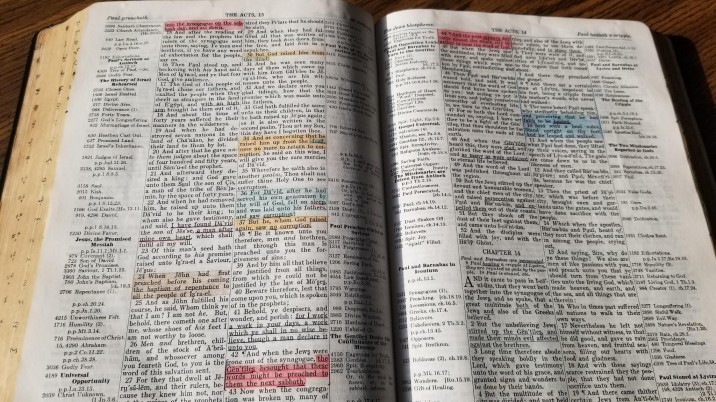

All references to the Sabbath in this Bible are marked in red — like a stop sign, to signify the Sabbath rest. If people would just read the red, then wouldn't they have to believe that the early New Testament Church kept the Sabbath — and admit it should be observed today?


I thought it was an air-tight argument. If anyone disagreed with the Christian obligation of Saturday Sabbath observance, then they just didn't believe the Bible. They weren't yet “called” to understand this truth, which we associated with “the Truth.”

My understanding of Sabbath observance, however, changed after a more careful, open-minded reading of the Bible.

Yes, the Acts of the Apostles gives authoritative witness to Saturday Sabbath observance at the very beginning of the Church, but let's notice what many overlook.

For your convenience, the passages under discussion are listed below.

The “Sabbath verses”

🛑 Acts 13:13-14:

Now Paul and his companions set sail from Paphos and came to Perga in Pamphylia. And John left them and returned to Jerusalem, but they went on from Perga and came to Antioch in Pisidia. And on the Sabbath day they went into the synagogue and sat down.

🛑 Acts 13:42,44:

As they went out, the people begged that these things might be told them the next Sabbath. ...The next Sabbath almost the whole city gathered to hear the word of the Lord.

🛑 Acts 15:21:

For from ancient generations Moses has had in every city those who proclaim him, for he is read every Sabbath in the synagogues.

🛑 Acts 16:13:

And on the Sabbath day we went outside the gate to the riverside, where we supposed there was a place of prayer, and we sat down and spoke to the women who had come together.

🛑 Acts 17:1-3:

Now when they had passed through Amphipolis and Apollonia, they came to Thessalonica, where there was a synagogue of the Jews. And Paul went in, as was his custom, and on three Sabbath days he reasoned with them from the Scriptures, explaining and proving that it was necessary for the Christ to suffer and to rise from the dead, and saying, “This Jesus, whom I proclaim to you, is the Christ.”

🛑 Acts 18:4:

And he reasoned in the synagogue every Sabbath, and tried to persuade Jews and Greeks.

Leading questions

A well-versed Sabbathkeeping Christian trying to persuade an average Sundaykeeping churchgoer can dominate him with these passages, accompanied by leading questions that are commonly asked:

  • On which day did Paul and his companions come to the synagogue?
  • On which day did the people want them to return? And who was it that came back the next Sabbath — only the Jews? Or was it “the whole city,” including Gentiles? Why didn't Paul say, “Hey, Gentiles, no need to wait a whole week. Just come back tomorrow — on Sunday, the Lord's Day”?
  • In every city, on which day each week was the Law read?
  • On which day did Paul go to the riverside looking for a place of prayer?
  • On which day was it Paul's custom to reason from the Scriptures?

The obviously true answer to these question is: the Sabbath, or Saturday.

But that doesn't prove what our interlocutor thinks it proves.

Nevertheless, such an encounter can frustrate a person of simple faith, leaving him short of a good explanation. Most are not prepared to counter such non-traditional views.

This is not unlike the average Christian who might feel overwhelmed or tongue-tied by an articulate Jehovah's Witness citing Bible verses in a well-rehearsed presentation “proving” Jesus is not God.

The response

When faced with the claim that New Testament examples of Sabbathkeeping mean we, too, should be keeping Sabbath, remember these two hot-knife facts that cut through the soft butter of that argument:


🔪 #1: There is not one example in all the Bible of any established Christian church meeting together in observance of the Sabbath.

🔪 #2: Without exception, every time Sabbath meetings are mentioned in the book of Acts, it is in the context of evangelization — preaching the gospel of Jesus to the Jews and the God-fearing Gentiles who associated with them.


I can't emphasize Fact 1 enough. It's a shocker to Christian Sabbathkeepers. They usually can't get beyond it, because they refuse to believe it. “What about all those red verses in Acts?” they might ask.

Fact 2 answers their question. While it's easy to understand intellectually, it's very hard to accept psychologically for the one who has defended Sabbathkeeping for years.

Go back and review the scriptures cited above. I trust you to dig deeper and see the truth for yourself in context:

Paul and his companions went on missionary journeys to preach the gospel, going first to the Jews. Where better to start spreading the gospel at that time than the synagogues — to explain how Jesus was Israel's Messiah, how he was the fulfillment of their entire religion?

And what better day than the Sabbath, when the synagogues were full of people (Jews and God-fearing Gentiles) who wanted to hear the Scriptures — those who deserved to understand them in light of the resurrected Christ?

They were following the precedent Jesus set in his instructions to the apostles when he first commissioned them to preach:

These twelve Jesus sent out, instructing them, “Go nowhere among the Gentiles and enter no town of the Samaritans, but go rather to the lost sheep of the house of Israel. And proclaim as you go, saying, ‘The kingdom of heaven is at hand.’” (Matthew 10:5-7)

In his epistles, St. Paul emphasizes the importance of reaching the Jews with the gospel. Naturally they would be first, and then the gospel would advance to the rest of the world. It's how the early Church began.

For I am not ashamed of the gospel, for it is the power of God for salvation to everyone who believes, to the Jew first and also to the Greek. (Romans 1:16)

This is consistent with how even Jesus chose to reveal himself:

He came to his own, and his own people did not receive him. But to all who did receive him, who believed in his name, he gave the right to become children of God.... (John 1:11-12)

“Another day”

When I came to understand these simple facts that I had overlooked for years — namely, that the Jews were evangelized by the first Christians at the synagogues on the Sabbath day, and that there is no biblical example of established Christian churches meeting together for the Sabbath — I was surprised.

But soon I was surprised again. I was surprised by Sunday.

Here, I share What I Didn't Know About Sunday.


The COG Catholic currently blogs at www.cogcatholic.org.